
Understanding filtration, airflow, static pressure, and how to choose the right filter for your home.
When shopping for a furnace or HVAC filter, it is easy to assume that a higher MERV rating means better protection for your home. After all, if a MERV 13 filter captures more particles than a MERV 8 filter, choosing the higher number sounds like the obvious decision.
But HVAC filters are not quite that simple.
A filter does more than clean the air. It also affects how easily air can move through your heating and cooling system. Choosing a filter that is too restrictive for your equipment can reduce airflow, increase operating pressure, and potentially affect comfort and system performance.
So, is a higher MERV filter always better? Not necessarily.
MERV stands for Minimum Efficiency Reporting Value. It is a rating system used to describe how effectively an air filter captures airborne particles. In general, the higher the MERV rating, the smaller the particles the filter can capture.
At first glance, this makes choosing the highest available rating seem logical. The problem is that filtration efficiency is only one part of the equation.
Your furnace, air handler, and air conditioner are designed to move a specific amount of air through the duct system. Air enters through the return ducts, passes through the filter and HVAC equipment, and is then distributed back into the home through the supply ducts.
Every filter creates some resistance to airflow.
Generally, a denser filter that captures smaller particles can create more resistance than a less restrictive filter. The actual pressure drop depends on the filter design, size, thickness, condition, and airflow through it.
If the system has difficulty pulling enough air through the filter, several problems can develop.
Reduced Airflow
One of the first signs may be weaker airflow from the supply vents. Rooms may take longer to heat or cool, and homeowners sometimes assume there is a problem with the furnace or air conditioner when the filter or airflow is contributing to the issue.
Longer Heating and Cooling Cycles
When less conditioned air reaches the rooms, the system may need to operate longer to reach the thermostat setting. That can affect comfort and potentially increase energy consumption.
Increased Stress on the Blower
The blower motor has to move air against the resistance of the duct system, filter, coil, registers, and other components. Excessive restriction can increase static pressure inside the system.
Modern variable-speed blowers may attempt to compensate by increasing their operating speed, which can sometimes result in more airflow noise or increased electrical consumption.
Furnace Temperature Problems
During heating operation, the furnace relies on airflow to carry heat away from the heat exchanger. If airflow becomes too low, the furnace temperature can rise excessively and may cause the high-limit safety switch to shut the burners off.
In some cases, homeowners notice the furnace repeatedly heating, shutting down, and restarting.
Air Conditioner Coil Problems
During cooling operation, warm indoor air must continuously move across the evaporator coil. Insufficient airflow can cause the coil temperature to drop too low. Under certain conditions, moisture on the coil can freeze.
A frozen evaporator coil can significantly reduce cooling performance and may eventually result in little or no airflow from the vents.
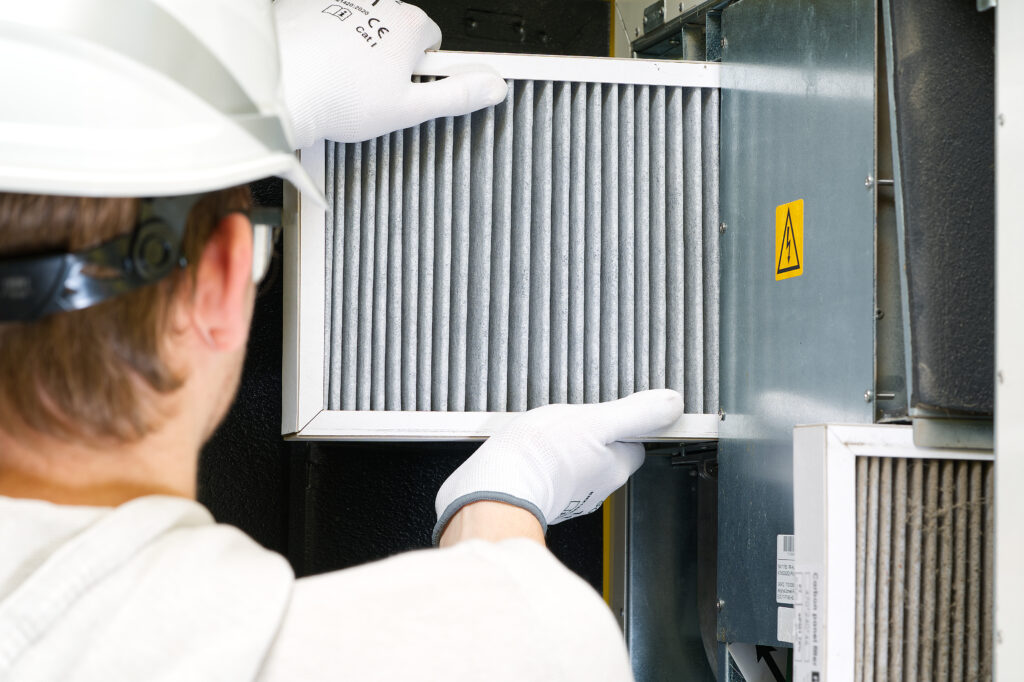
No. Higher-efficiency filters can be an excellent choice when the HVAC system is designed to accommodate them. The important question is not: “What is the highest MERV filter I can buy?” It is: “What level of filtration can my HVAC system handle while maintaining proper airflow?” A properly designed system may be able to use a MERV 11 or MERV 13 filter without any problem.
Another system – especially one with undersized return ductwork, a small filter rack, or existing airflow restrictions – may perform better with a less restrictive filter.
MERV rating is not the only factor that affects airflow. The physical size of the filter makes a major difference. A common 1-inch filter has much less surface area than a 4-inch or 5-inch media filter. A deeper media filter contains more pleated material, creating more surface area for air to pass through. Because of this, a properly sized 4-inch or 5-inch media filter may provide better filtration while creating reasonable resistance compared with some highly restrictive 1-inch filters. This is one reason upgrading the filter cabinet can sometimes be more effective than simply purchasing a higher-rated 1-inch filter.
Even the correct filter can cause airflow problems if it becomes heavily loaded with dust. As particles accumulate inside the filter, the resistance increases. How often a filter needs replacement depends on several factors, including:
Instead of relying only on a fixed replacement schedule, homeowners should inspect the filter regularly. A filter that looks heavily loaded or causes noticeable airflow reduction should be replaced.
There is no single MERV rating that is perfect for every home. For many residential HVAC systems, filters in the MERV 8 to MERV 13 range may be considered depending on the equipment and ductwork.
Before significantly increasing the filtration level, it is worth considering:
For homeowners who want improved filtration, simply installing the highest-rated filter available is not always the best solution.
HVAC technicians can measure the static pressure inside a forced-air system.
Static pressure is similar to blood pressure for an HVAC system – it provides useful information about how difficult it is for the blower to move air through the equipment and ductwork. If static pressure is already high, installing a more restrictive filter may make the situation worse. If airflow and static pressure are within the proper range, the system may be able to accommodate higher-efficiency filtration without sacrificing comfort or performance. This makes an airflow assessment particularly useful when homeowners are considering upgrading their filtration system.
The HVAC filter is an important part of indoor air quality, but it is not the only factor. A comfortable and healthy indoor environment may also depend on:
The best filtration strategy is one that improves air quality without interfering with the HVAC system’s ability to move air properly.
A higher MERV number does not automatically mean a better filter for your particular HVAC system. Better filtration can be beneficial, but airflow must always be considered.
The right filter should strike a balance between particle capture, airflow, equipment performance, and indoor comfort.
If you are unsure whether your furnace or air handler can accommodate a higher-MERV filter, an HVAC technician can evaluate the filter setup, airflow, and static pressure before making a recommendation.
Sometimes improving indoor air quality is as simple as changing the filter. Other times, the better solution is improving the filter cabinet, return-air system, or overall HVAC airflow rather than simply choosing the highest number on the shelf.
If you are planning to replace your furnace, air conditioner, heat pump, water heater, or tankless system, iCare Home Comfort can help you understand the process and choose the right solution for your home.
GTA Leading provider of heating, cooling, and water heating and treatment needs for over 15 years.
Get 5% off when you sign up for emails with savings and tips.
© 2026 ICARE HOME COMFORT INC. Design by Tensor Canada | Privacy Policy | Terms and Conditions